Consultant Handoff Best Practices That Actually Work

Consultant Handoff Best Practices That Actually Work
The knowledge transfer meeting is scheduled. The consultants have prepared a 47-slide deck walking through the system they built. Your team nods along, takes notes, asks a few questions. Two weeks later, the consultants are gone. Two months later, your team is stuck on something they swear was never covered.
Sound familiar?
Here’s the uncomfortable truth: most consultant handoff failures aren’t caused by the handoff itself. They’re caused by how the engagement was structured from the beginning. By the time you’re scheduling transition meetings and compiling documentation, the outcome is largely already determined.
This article won’t give you a better slide deck template. It will show you how to structure engagements so the formal “handoff” becomes a formality—because your team has been building capability the entire time.
Why Most Consultant Handoffs Fail
Consultant handoffs fail because they treat knowledge transfer as an event rather than a process. The typical pattern looks like this: consultants build, your team observes, then everyone gathers in a conference room for a marathon documentation review before the contract ends.
The problem isn’t the review. It’s everything that came before it.
When your team watches consultants work instead of working alongside them, they learn what was built—not why it was built that way. They can follow the documentation, but they can’t adapt when something unexpected happens. They know the system exists, but they don’t have the muscle memory to extend it.
Documentation captures decisions. It doesn’t transfer judgment.
The other failure mode is timing. Most engagements back-load all the teaching into the final two weeks. But learning complex systems takes repetition, practice, and mistakes. You can’t compress six months of context into a few sessions, no matter how thorough the materials are.
If your handoff plan starts in month five of a six-month engagement, you’re not planning a handoff. You’re planning a gap.
Industry data bears this out: 20-30% time shortfalls on enablement activities are common across consulting engagements. Most projects simply don’t allocate enough time to capability building—and by the time anyone notices, it’s too late to fix.
The “No-Handoff Handoff”—What Success Looks Like
The best consultant handoffs are the ones where there’s almost nothing left to hand off.
This sounds paradoxical, but it’s the pattern we see in engagements that actually stick. When the consultants leave, the client team doesn’t feel like they’re taking over something foreign. They feel like they’re continuing work they’ve been doing for months.
Here’s what that looks like in practice:
Your team has been in the room for every major decision. Not reviewing decisions after they’re made—participating in making them. When someone asks “why did we build it this way?” six months later, at least one person on your team can answer from memory, not from documentation.
Your engineers have committed code to the codebase. They’ve debugged issues. They’ve paired with the external team on features. The system isn’t something that was built and then given to them—it’s something they helped build.
Your product lead can run the design review without consultants present. They know the design system, the component library, the patterns. They’ve been practicing, not spectating.
The “handoff meeting” is short. There’s a checklist of credentials to transfer, a few edge cases to document, maybe some architectural decisions worth writing down for future reference. But nobody’s learning the system for the first time. They’re just formalizing what everyone already knows.
This is what we call the “no-handoff handoff.” The transition is invisible because capability transferred continuously throughout the engagement.
How to Structure Engagements for Continuous Transfer
You can’t retrofit this at the end. It has to be designed in from the start.
Define exit criteria in week one. Before work begins, answer this question: “What will our team be able to do independently when this engagement ends?” Not “what will be delivered”—what will your people be capable of? Write it down. Make it a milestone. If you can’t define it, you’re not ready to start.
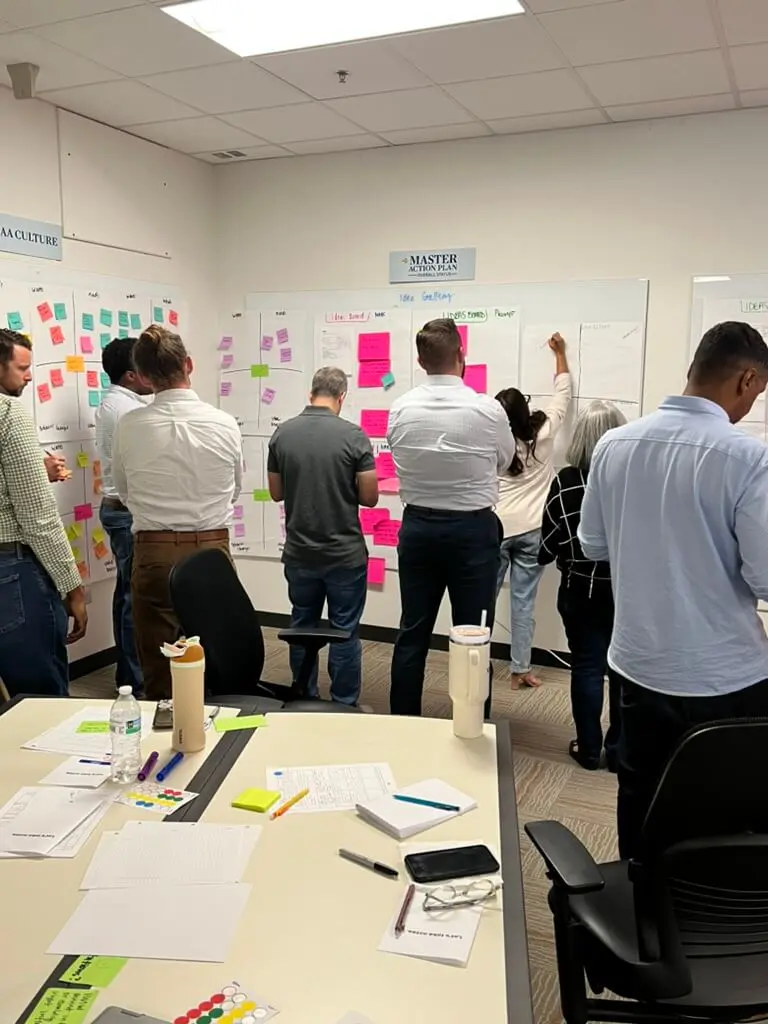
Require embedded participation, not observation. Your team shouldn’t be watching from the sidelines. They should be in the same Slack channels, the same standups, the same working sessions. If the consultancy wants to work in a separate silo, push back. There might be good reasons—but often there aren’t.
Establish pairing ratios. For technical work, we recommend at least one internal engineer working alongside each external one. Not shadowing—actually building together. This slows things down in the first few weeks. By month two, it accelerates everything because your team is contributing instead of waiting to receive. Embedded models with 1:3-5 consultant-to-internal ratios show 30-50% better transfer outcomes than traditional approaches where consultants work in parallel.
Co-create artifacts from the start. If the engagement will produce a playbook, your team should help write it. If there’s a component library, your designers should be adding to it. When artifacts are co-created, there’s no “handover” of documentation—your team already knows what’s in it because they helped build it.
Build in capability checkpoints. At regular intervals—monthly works well—ask: “Could our team run this without the consultants present?” If the answer is no, figure out why. What’s blocking autonomy? Address it now, not in the final week.
Front-load the teaching. Most engagements back-load training. Flip that. Best practice allocates 15-25% of total engagement time to capability building, front-loaded in the early weeks. Invest heavily in pairing, context-sharing, and guided practice in months one and two. The engagement should get less dependent on consultants over time, not more.
The goal is a graph that trends toward independence. If consultant involvement stays flat or increases as you go, something’s wrong with the structure.
Already Mid-Engagement? Here’s What to Do Now
Maybe you’re reading this three months into a six-month project and realizing the handoff is going to be rough. It’s not too late to improve it—but you’ll need to act fast.
Start pairing immediately. Even if you can’t restructure the whole engagement, you can get your team into working sessions now. Every week of paired work is a week of capability building you didn’t have before.
Identify the highest-risk knowledge. What parts of the system are most complex? What decisions were made that only the consultants fully understand? Prioritize those for immediate knowledge transfer—not through documentation, but through joint work on real tasks in those areas.
Schedule mid-engagement checkpoint meetings. Don’t wait for the final handoff. Run a trial now. Have your team attempt to operate a portion of the system without consultant involvement. See what breaks. That’s your curriculum for the remaining weeks.
Negotiate timeline if needed. If the engagement is ending and your team isn’t ready, it may be worth extending—but only if you use the extra time for capability building, not just more consultant-led delivery. An extra month of the same structure won’t help.
Document the “why,” not just the “what.” If you’re in catch-up mode, make sure documentation captures the reasoning behind decisions, not just the decisions themselves. “We chose this API because of X constraint and Y tradeoff” is useful. “API documentation: see link” is not.
You can’t fully recover from a poorly structured engagement in the final weeks. But you can significantly reduce the gap.
The Handoff Checklist That Actually Matters
When it’s time for the formal transition, here’s what needs to transfer. This isn’t a substitute for continuous capability building—but it’s the tactical layer that ensures nothing falls through the cracks.
Access and Credentials
Transfer ownership of all repositories, environments, accounts, and tools. Remove consultant access. Verify your team can deploy, configure, and administer everything without external help. Test this before the last day, not on it.
Documentation of Decisions
Not documentation of the system—your team should already know the system. Documentation of the decisions that aren’t obvious from the code or configuration. Why did we structure data this way? What edge cases does this workflow handle? What did we explicitly decide not to build, and why?
Runbooks for Recurring Tasks
Deployment procedures, monitoring checks, common troubleshooting steps. These should be written by your team with consultant review, not the other way around. If your team writes it, they’ll actually use it.
Escalation Paths
Who do you call if something breaks that’s beyond your team’s current capability? Even well-structured engagements may leave some advanced scenarios for future learning. Name those explicitly and have a plan.
Open Items and Known Gaps
What’s unfinished? What’s known to be fragile? What would you do differently with more time? Honest documentation of limitations prevents surprises later.
The “Bus Test”
Before the consultants leave, have them identify the two or three things that would be hardest for your team to figure out alone. Make sure those are explicitly addressed—through documentation, pairing, or recorded walkthroughs.
A handoff checklist is necessary. But if you’ve structured the engagement well, working through it should feel like a formality, not a fire drill.
Signs Your Handoff Worked—And Signs It Didn’t
How do you know if the transition actually succeeded? You won’t know for certain until months later, but there are early indicators.
The data on this is striking: knowledge transfer alone—documentation, training sessions, slide decks—yields roughly 40% retention. Capability transfer, built through hands-on practice and shared ownership, reaches 80-90%. The difference shows up in whether your team can adapt when something unexpected happens.
Signs it worked:
Your team starts extending the system within weeks of the consultants leaving—not just maintaining it, but adding new capabilities. Questions that come up get answered internally, not escalated to former consultants. The documentation exists but rarely gets referenced because people remember. When new team members join, existing staff can onboard them without external help.
Signs it didn’t:
Your team avoids touching certain parts of the system because “only the consultants understood that.” You find yourself emailing the former engagement lead with questions months later. The documentation gets referenced constantly—because nobody internalized the knowledge. When something breaks, the first instinct is to call for outside help rather than troubleshoot internally.
The clearest signal? Six months after the engagement ends, ask your team: “Could we rebuild this if we had to?” If the answer is yes, the handoff worked. If the answer is hesitation, the capability didn’t fully transfer.
The best consultant handoff practices aren’t really about the handoff at all. They’re about structuring engagements so your team builds capability from day one—so that by the time the consultants leave, there’s nothing left to hand off.
Start with the exit in mind. Embed your team in the work. Co-create everything. And treat the formal handoff as a checklist, not a curriculum.
When you get this right, the consultants become temporary teammates who accelerate your team’s growth—not permanent dependencies you can’t escape. That’s the difference between reducing consultant dependency and perpetuating it.
Want to talk about structuring your next engagement for real capability transfer? Get in touch—we’ll share how we build the handoff into the engagement from day one.