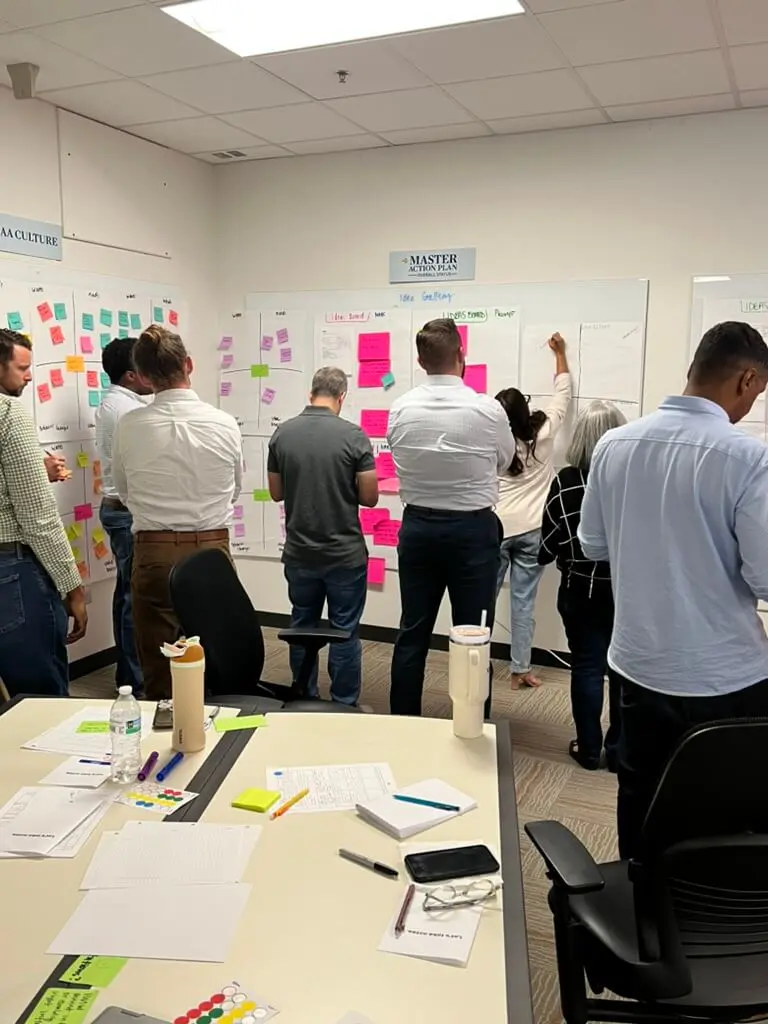
Digital Experience Consulting: 6 Questions Before You Hire


Last updated: March 2026
A product team spends over a year building a customer portal. The whole point was to cut call center volume and drive digital self-service. It looked great in demos. Six months post-launch: adoption in the low double digits, satisfaction scores flat, call center busier than ever.
The portal worked technically. It just didn’t solve the problems customers were actually trying to solve. And when the consultants left, no one on the internal team knew how to fix it.
That pattern is the most common failure mode in enterprise digital work. Well-built product, low adoption, confused handoff. It’s not a technology problem. It’s a consultancy problem: the firm built a deliverable and left, instead of building your team’s ability to run it.
If you’re evaluating digital experience consulting partners, this guide gives you the framework to tell the difference before you sign anything.
What Is Digital Experience Consulting?
Digital experience consulting is the work of designing, building, and scaling the digital products your customers and employees actually use, and making sure your team can keep running them after the engagement ends.
Gartner defines digital experience services as those that “design, deliver, and optimize digital experiences across customer, employee, and citizen journeys using technology solutions.” For enterprise teams, that means closing the gap between what your organization knows it needs and what it’s currently able to ship, across product strategy, UX design, software engineering, and organizational capability.
That gap is usually not strategy. It’s execution capacity, AI-native thinking, and the ability to validate with real users before building at scale.
How Consultancies Differ from Agencies and In-House Teams
Most organizations evaluate three options when they need to move faster on digital products. Here’s the breakdown:
| Digital Experience Consultancy | Agency | In-House Team | |
|---|---|---|---|
| Strategy depth | High (shapes what gets built and why) | Low to medium (executes what you define) | Variable, depends on leadership |
| Engineering | In-house, full-stack | Often outsourced or thin | Strong over time |
| Design | Human-centered, research-backed | Strong creative, lighter on research | Variable |
| AI-native capability | Architectural, built into the product | Bolted on if at all | Emerging |
| Team enablement | Core service, you keep the playbook | Rarely included | N/A |
| Speed to first working product | Weeks | Months | Quarters |
| Cost | $15K–$50K/month | $10K–$30K/month | $500K–$2M+/year |
The question isn’t which model is cheapest. It’s which model leaves you stronger.
Agencies deliver artifacts. In-house teams build institutional knowledge slowly. A consultancy that’s doing its job gives you both: the product and the capability to extend it.
One thing worth saying plainly about the big firms: Accenture, Deloitte, the usual names have the enterprise pedigree and the breadth, but engagements are slow, process-heavy, and often staffed by junior teams once the pitch crew rotates off. You pay for the brand. You work with the bench.
The alternative is direct engagement with the senior people. The strategists, designers, and engineers you meet in the pitch are the ones who ship your product. No rotation. No layers.
Why Most Enterprise DX Projects Fail
Research from McKinsey and BCG consistently finds that roughly 70% of digital transformation initiatives underperform or fail outright. The cause is almost never the technology. It’s adoption. Product analytics benchmarks put median feature adoption for enterprise software around 6–7%, which means most users never interact with the majority of what gets built.
The problem isn’t execution speed. It’s building the right thing and making sure the right people can run it.
Three failure patterns show up repeatedly:
The deliverable trap. The consultancy defines success as shipping the thing, not as users adopting it. You get a polished product and a wave goodbye. Three months later, you’re trying to figure out how to extend something you don’t fully understand.
Pilot purgatory. The engagement produces something that works in a controlled environment but never reaches the bottom line. You have a proof of concept, not a product. Six months burned to find that out.
The dependency loop. The consultancy architects a system that only they can maintain. Every change request goes back through them. The engagement doesn’t end. It just becomes a retainer you didn’t plan for.
The antidote to all three is the same: choose a partner whose success metrics are your adoption numbers and your team’s capability, not their billable hours.
The capability stays when we go. That’s not a nice-to-have. It’s the whole point.
6 Questions to Ask Before You Hire a Digital Experience Consultancy
These aren’t soft questions about culture fit. They’re the ones that expose whether a consultancy is built to transfer capability or built to create dependency.
1. Can you show me what my team keeps after the engagement ends?
Push past the vague answer. You want specifics: a component library your engineers can extend, a design system your designers own, a playbook your product team runs without help. If they can’t name the artifacts, they probably don’t leave them.
2. How does my team work alongside yours, not just review what you build?
Capability transfer doesn’t happen through handoff decks. It happens through pairing. Your engineers should be in the code reviews. Your designers should be in the design system decisions. If the answer is “we’ll do knowledge transfer at the end,” that’s a red flag.
3. What ships in the first four weeks?
A working consultancy ships a functional prototype in the first sprint. Not a deck, not a discovery report, not a roadmap. If week four doesn’t produce something your users can interact with, reconsider the scope.
4. How do you validate with real users before building at scale?
The portal story in the intro wasn’t a bad idea poorly executed. It was a good-looking idea built without real user validation. Ask specifically how they run research, how fast, and at what fidelity. “Human-centered design principles” is not a research process.
5. What does the engagement look like after the first three months?
The answer you want: “By month three, your team runs the playbook we built together.” The answer that should worry you: an open-ended engagement with no defined point at which your team takes over.
6. Have you shipped this in our industry?
Financial services, healthcare, insurance. These aren’t just vertical checkboxes. Compliance requirements, legacy system constraints, and stakeholder complexity in these industries are different enough that “we’ve built enterprise products” isn’t sufficient. Ask for specifics.
[VISUAL PLACEHOLDER: Checklist-style graphic of the 6 questions, formatted for easy screenshot/download]
What a Good Engagement Actually Looks Like
Here’s the timeline frame we use. Not aspirational. This is the operating model:
Week 1: Prototype. Not a mockup. A working prototype your users can interact with. Week 2: Validate. Real users, real feedback, course corrections before you build at scale. Week 4: Ship. First functional component in production. Month 3: Autonomy. Your team extends the system without us.
Three weeks into a recent engagement, our designers hadn’t opened Figma. Claude Code was the design tool. That’s what AI-native actually looks like in practice: not a chatbot bolted onto your product, but AI woven into how the work gets done from day one.
The artifacts you keep at the end of a well-run engagement:
- A design system your designers own and your engineers can implement without calling us
- A component library that ships faster per feature as it grows
- A development playbook that documents the decisions we made and why
- An adoption dashboard that shows what’s working and what isn’t
This isn’t documentation theater. It’s the mechanism that turns a consulting engagement into a durable capability.
For enterprise teams in financial services and healthcare, we also build with compliance guardrails from day one, not retrofitted at the end when they’re most expensive.
Want to see how this works for your team? Explore our approach to AI-enabled product design or read how we think about team enablement.
If you’ve been burned before by consultants who left without transferring the capability, this piece on reducing consultant dependency breaks down exactly where those engagements go wrong structurally.
Frequently Asked Questions
What’s the difference between a digital experience consultancy and a digital agency?
An agency focuses primarily on creative execution: design, content, and brand. A digital experience consultancy combines strategy, design, engineering, and enablement to build products that work at a technical and organizational level. The key difference is capability transfer. A consultancy leaves your team stronger. An agency leaves you a deliverable.
How long does a typical digital experience consulting engagement last?
Most engagements run 3–6 months for an initial product build, with a clear handoff point at which your team takes over. Be cautious of open-ended engagements with no defined autonomy milestone, because that structure is how dependency gets built in. See our piece on consultant exit strategy and capability transfer timelines for what a well-structured handoff looks like.
How do I know if we need a consultancy or just more in-house hiring?
If you need to move in weeks, not quarters, and you need AI-native product thinking you don’t currently have, a consultancy gets you there faster. If you have the time and the hiring market is cooperating, building in-house gives you long-term control. Most enterprise teams use consultancies to accelerate a specific capability, then maintain it themselves. Our digital product development page covers how we scope that kind of engagement.
What does a digital experience consultancy cost?
Senior-only shops typically run $15K–$50K a month, or $50K–$500K per project depending on scope. That’s more than an agency for the same calendar time, but the math changes when you factor in what you keep and what you avoid. A six-month engagement that leaves your team running the playbook independently is a fundamentally different investment than one that generates a follow-on retainer you didn’t plan for.
What should be in scope for a first engagement?
Start with the highest-friction point in your user experience: the place where users drop off, call in, or work around your product. A well-scoped first engagement solves one real problem well, ships something users interact with in week four, and leaves your team owning the system. Avoid consultancies that push for a six-month discovery phase before anything is built. If you’re not sure where to start, our strategy and innovation services are built for exactly that moment.
The difference between a digital experience project that sticks and one that becomes a cautionary story isn’t the technology. It’s whether the consultancy was building for the handoff or against it.
The right partner ships fast, validates with real users, pairs with your team while they work, and leaves you running the playbook by month three.
Ready to see what that looks like for your organization? Schedule a Clarity Sprint with Cabin — we prototype, validate, and ship digital experiences that your team can own and extend.
About the author
Cabin is an AI transformation consultancy that architects AI-native products, implements intelligent systems, and builds client team capability while doing it. Founded by the core team behind Skookum, which became Method under GlobalLogic and rolled up to Hitachi, Cabin’s partners have shipped 40+ enterprise products together over nearly 20 years, for clients including FICO, American Airlines, First Horizon, Mastercard, Trane Technologies, and SageSure.
Digital experience is where Cabin operates every day, not as an advisor watching from the sidelines, but as the senior strategists, designers, and engineers doing the work. The team has navigated enterprise DX engagements across financial services, healthcare, and insurance, building products that ship in weeks and capability that stays after the engagement ends.
Everything Cabin publishes on digital experience, AI-native product design, and team enablement comes from work currently in progress, not from research reports or conference decks. When we write about what goes wrong with enterprise DX projects, it’s because we’ve inherited the aftermath. When we write about what a good handoff looks like, it’s because we’ve built the playbooks.