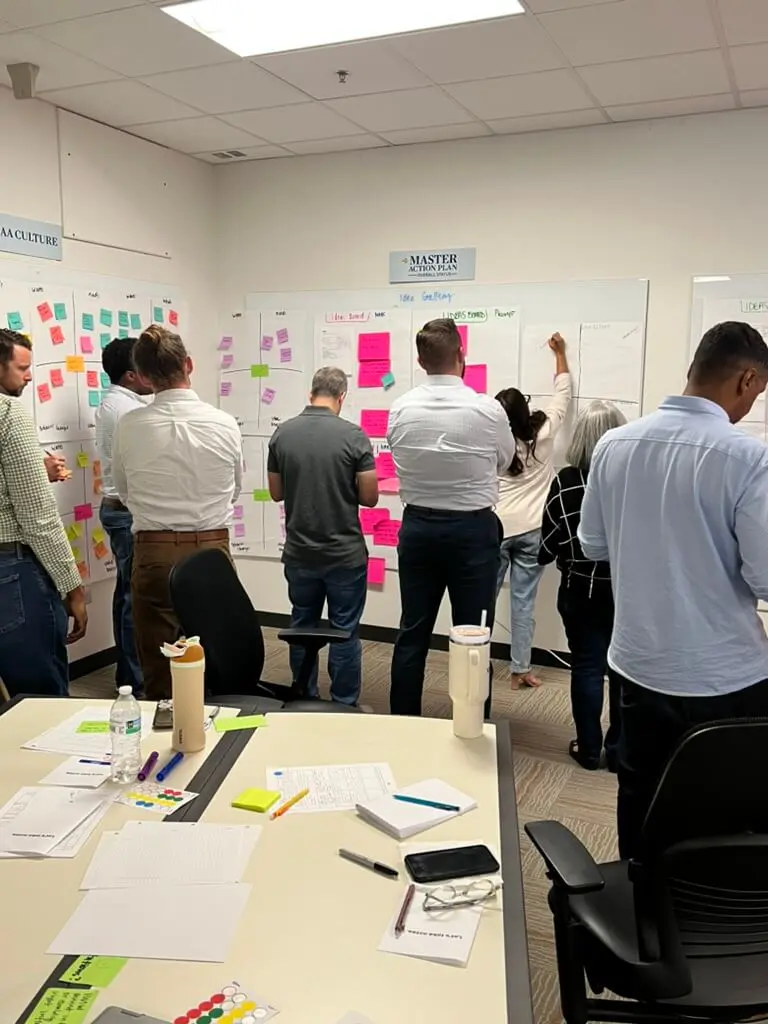
Digital Product Strategy: Choices That Actually Guide the Work


A digital product strategy is the set of choices that decides what you will build, for whom, and why, so that day-to-day decisions get easier instead of harder. A real strategy makes tradeoffs: it says what you are not doing, not just what you are. If your strategy could be pinned to any product at any company and still read as true, it is a mission statement, not a strategy.
The reason most product strategies fail is not that they are wrong. It is that they are not actually strategies. They are vision statements that inspire but decide nothing, or backlogs that list everything and prioritize nothing. This guide covers what a strategy has to answer, why tradeoffs are the whole point, how strategy connects to the roadmap and the daily work, and how to write one your team will actually use.
What a digital product strategy has to answer
A useful digital product strategy answers four questions clearly enough that a team can make decisions without escalating every one.
- Who is it for? The specific customer and the job they are hiring the product to do. Naming everyone means naming no one, and a product built for everyone tends to be loved by no one.
- What is the bet? The differentiated value you are choosing to be genuinely great at, and, just as important, the things you are deliberately choosing to be merely adequate at. A bet with no sacrifice is a wish.
- How does it win? Why this product, from this company, beats the alternative the customer would otherwise choose, including the powerful alternative of doing nothing.
- How do we know? The small number of outcomes that tell you the strategy is working, so you can correct in-quarter instead of discovering the miss at the annual review.
If the strategy cannot answer these four in plain language, it will not settle arguments, and settling arguments in advance is most of what a strategy is for.
The strategy stack: vision, strategy, roadmap
These three get conflated constantly, and the confusion is expensive. Vision is the long-term destination, the world you are trying to create, and it should be stable for years. Strategy is the set of choices about how you get there from where you are now, and it should evolve as you learn. The roadmap is the sequenced set of bets that expresses the current strategy, and it changes most often. When teams argue in circles, it is usually because they are debating roadmap items without an agreed strategy, or defending a strategy that no longer serves the vision. Name which layer you are actually discussing and the argument usually resolves.
Strategy is a set of tradeoffs, not a backlog
The most common failure is a strategy that is really just a prioritized list of everything the team could build. A backlog tells you the order of the work. A strategy tells you which work is off the table and why. The two are not the same, and one cannot substitute for the other.
Here is the test in practice. A promising request comes in from a big customer that does not fit the bet. With a real strategy, the team can say no in a sentence, because the strategy already made that call. Without one, the request triggers a meeting, a debate, and usually a yes that quietly widens the product until it is mediocre at everything. If every good idea survives contact with your strategy, the strategy is not doing its job. A strategy is defined as much by the strong ideas it declines as by the ones it pursues.
How to write the bets
Turn the strategy into a short set of explicit bets a team can carry into discovery and delivery. A good bet names the customer and job, states the differentiated value, and is honest about what it costs you elsewhere. For example: “We win mid-market finance teams who need audit-ready reporting by being the fastest to a defensible report, and we accept being weaker on deep customization than the enterprise incumbents.” That reads like a decision. It tells a team what to optimize and what to let go, and it can be argued with, which a vision statement cannot.
Keep the set small. Three or four bets a team can hold in their heads beat a twenty-page document nobody reopens. The bets are the interface between strategy and the work.
From strategy to shipped product
Strategy earns its keep only when it changes what gets built. The link between the two is the set of bets above, connected to outcome-based goals so the team knows what result each bet is meant to produce. The fastest way to find out whether a bet is right is to ship a narrow slice of it, so an early MVP is often the best strategy document you will ever produce, because it turns an assumption into evidence. What you learn from real usage should feed straight back into the bets, which is why a digital product strategy is continuous, not annual. The plan and the reality are supposed to argue with each other.
How to communicate a strategy so it sticks
A strategy that lives only in the product leader’s head is not a strategy the org can act on. Write it down in one page: the customer, the bets, how you win, and how you will know. Repeat it often enough to feel repetitive, because the point at which you are tired of saying it is roughly the point at which the org has heard it once. Tie roadmap decisions back to it out loud, so people see the strategy being used to make real calls. A strategy is socialized through consistent decisions, not through a single launch presentation.
Where digital product strategies fall apart
- Vision with no tradeoffs. Inspiring language that never says what you will not do, so it never settles a single argument.
- Strategy by feature list. A roadmap of features standing in for a point of view about how you win.
- Set once, never revisited. A strategy written in January and ignored by March, overtaken by evidence it never absorbed.
- No line to delivery. A strategy the build team never sees or uses, so the work drifts back to whatever is loudest.
- Strategy by consensus. Watering down every hard choice until everyone agrees, which produces a document that offends no one and guides no one.
Frequently asked questions
What is the difference between product strategy and product vision?
Vision is the long-term destination, the world you are trying to create. Strategy is the set of choices about how you get there from where you are now. Vision inspires and stays stable; strategy decides and evolves as you learn.
How often should we revisit our digital product strategy?
Whenever real evidence contradicts a bet, and on a light quarterly cadence otherwise. A strategy that never changes is either perfect or ignored, and it is rarely perfect. Revisiting is not flip-flopping; it is responding to what you learned.
Who owns the digital product strategy?
Product leadership owns it, but it is shaped with design, engineering, and the business so that it is both feasible and fundable. A strategy built in isolation tends to assume things the people who ship cannot deliver, or that finance will not fund.
How is product strategy different from a roadmap?
Strategy is the set of choices about how you win; the roadmap is the sequenced bets that express those choices right now. Strategy is relatively stable, the roadmap changes as you learn, and the roadmap should always be traceable back to the strategy.
How do OKRs relate to product strategy?
Objectives and key results translate the strategy into measurable outcomes for a period. The strategy decides where to aim; OKRs state the specific results that will tell you the aim is right. OKRs without a strategy behind them tend to become a list of disconnected metrics.
What if leadership will not commit to tradeoffs?
Then you do not yet have a strategy, you have a wish list, and it is worth naming that plainly. Force the tradeoff with a concrete choice: show two credible paths and the cost of each, and make leadership pick. A strategy is the record of choices actually made, not options kept open forever.
Turn strategy into shipped bets
A strategy is worth having only if it changes what you build next. We help leaders set a digital product strategy with real tradeoffs, then build the first bets with your team so the plan meets reality quickly and the strategy improves from evidence rather than opinion. See how we approach strategy and product advisory, or get in touch and we will pressure-test the bets you are weighing.