
Accenture Competitors: How to Choose the Right Alternative


If you are searching for Accenture competitors, you are usually not shopping on price. You are trying to work out whether the thing you need is scale or attention, because those two live at opposite ends of this market and almost nobody says so in a pitch.
Last updated: November 9, 2026
Here is the honest version of the landscape, including where a firm the size of Accenture is genuinely the right answer.
Who are Accenture’s competitors?
Accenture’s competitors fall into four groups: the other global system integrators, the Big Four consulting arms, the offshore-led IT services firms, and the specialist product and engineering shops.
The scale gap between those groups is the single most important thing to understand before comparing them.
- Global system integrators. IBM Consulting, Capgemini, Cognizant, DXC.
- Big Four consulting arms. Deloitte, EY, KPMG, PwC.
- Offshore-led IT services. Infosys, TCS, Wipro, HCLTech, Tech Mahindra.
- Specialist product and engineering firms. Thoughtworks, Slalom, West Monroe, and independent boutiques including Cabin.
For calibration on what “global scale” means: Accenture reported revenues of $69.7 billion for fiscal 2025 and approximately 779,000 people as of August 31, 2025, in its annual report on Form 10-K for the year ended August 31, 2025. A firm of that size is a genuinely different instrument from a fifty-person team, and comparing them on rate card misses the point entirely.
What you are actually choosing between
Strip away the positioning and there are two variables that predict how an engagement will feel.
**Coverage.** Can one firm staff every discipline, in every geography, at once, and stand behind the whole outcome? Large integrators can. Boutiques cannot, and pretending otherwise is the main way boutiques fail their clients.
**Senior density.** What fraction of the people doing your work have shipped this before? Large-firm economics depend on a staffing pyramid, which is not a criticism, it is how a firm supports several hundred thousand people and global coverage. It does mean the people who sold the work are usually not the people doing it.
Almost every complaint we hear about a large-firm engagement traces back to senior density, and almost every complaint we hear about a boutique engagement traces back to coverage. Choosing well is mostly about knowing which of those two risks you can absorb.
The four groups, compared honestly
| Group | Strongest at | Weakest at | Best fit |
| Global system integrators | Multi-year, multi-country programs with one accountable throat | Senior density on any single workstream, and speed of decision | ERP, large platform rollouts, and anything spanning ten countries |
| Big Four consulting arms | Board-level credibility, risk, regulatory, and audit-adjacent work | Building and running software long-term | Regulatory response, controls, and strategy that needs to survive a board |
| Offshore-led IT services | Cost per unit of delivery at scale, sustained operations | Ambiguous problems that need to be defined rather than executed | Run and maintain, large-scale migration with a clear specification |
| Specialist product and engineering | Senior density, speed, and defining a problem that is still fuzzy | Coverage, geography, and very large simultaneous scope | A product to build, a hard technical problem, a fast first version |
The caveat: these are structural tendencies, not verdicts about any individual firm or team. Excellent teams exist inside every group, and a bad engagement with any of them usually traces to a scope mismatch rather than to competence.
Choosing a partner
Want a straight read on whether you need a boutique at all?
We are a senior-only team, and the people you meet are the people who ship. We will also tell you when your scope genuinely calls for a global integrator instead, because a mismatched engagement costs you more than a referral costs us.
When a firm the size of Accenture is the right answer
Genuinely, and specifically:
- Scope spans many countries and disciplines at once. If you need tax, change management, ERP, and infrastructure moving in parallel across fifteen markets, that is what large integrators are built for.
- You need one accountable party for a very large outcome. Someone to carry the risk on a program too big to coordinate yourself.
- Procurement requires it. Some organizations cannot contract with a small firm at the size they need. That is a real constraint, not a failure of imagination.
- The work is sustained operations. Running something for years at predictable cost is a different capability from building something new.
Any boutique that tells you it can replace that is selling. We would not take that work, and we would say so in the first conversation.
When a specialist firm is the right answer
- The problem is not defined yet. Discovery under ambiguity rewards senior density more than process.
- You need something working in weeks. Small senior teams move faster because there are fewer people to align.
- The technical difficulty is concentrated. One genuinely hard system beats broad coverage.
- You want your team stronger afterward. This is the one worth being specific about, because everyone claims it.
On that last point, our own position: we architect the system, build it with your engineers in the room, and hand over the playbook so your team extends it without us. Our team has shipped 40 or more enterprise products together, most of us for well over a decade, on work for organizations including FICO, American Airlines, First Horizon, Trane Technologies, SageSure, and Mastercard. That is the trade we offer against coverage, and it is a real trade rather than a free lunch.
The five questions that decide it
Ask every firm on your shortlist, including us:
- Who exactly is doing the work? Names, seniority, and how much of their time. Then ask whether those names are contractually committed.
- What ships in the first six weeks? Not a milestone, an artifact somebody can use.
- What do we own at the end? Code, documentation, and the capability to change it, or a dependency.
- What would you tell us not to do? A firm with no answer has not thought about your problem yet.
- When would you refer us elsewhere? The most revealing question in the list.
Question one catches most of the gap between what was sold and what gets delivered, in any group. Question five catches whether you are talking to advisors or to a sales process.
The comparison people actually mean
Search behavior in this category is specific. Buyers look for Accenture competitors, Deloitte alternatives, and Slalom consulting competitors, and in almost every case the underlying question is the same: is there a smaller firm with more senior people that can do the part of this that is hard?
Often yes, for a defined scope. Rarely yes, for the whole program. The productive move is to split the work: use a specialist for the part that requires invention, and a large integrator or your own team for the part that requires coverage and endurance. Buyers who force a single vendor onto both halves usually get a compromise on the half that mattered.
If AI is the specific capability you are shopping for, we wrote a fuller shortlist view in best AI consulting firms, and the definition question is covered in what is AI consulting. For evaluating the document a strategy engagement produces, see IT strategy consulting, and for program-shaped work, digital transformation consulting.
Frequently asked questions
Who is Accenture’s biggest competitor?
It depends entirely on the work. For large technology programs, IBM Consulting, Capgemini, Cognizant, Infosys, and TCS compete most directly. For strategy and regulatory work, Deloitte, EY, KPMG, and PwC. For product and engineering, specialist firms compete on senior density rather than scale, and usually for a slice of the program rather than the whole thing.
Are boutique firms cheaper than Accenture?
Not reliably on a rate basis, and that is the wrong comparison. Senior-only teams often carry higher day rates and lower total cost, because the work takes fewer people and fewer cycles. Compare total cost to a defined outcome, not rate cards, and insist on knowing who is doing the work in both cases.
What is the risk of hiring a small firm?
Coverage and continuity. A small firm cannot staff every discipline at once, and key-person dependency is real. Mitigate it by scoping tightly, requiring documentation and pairing as deliverables, and being honest with yourself about whether your program needs breadth you are not buying.
Can we use both?
Yes, and for large enterprises it is often the best answer. A specialist defines and builds the hard core, and a larger partner or your internal team handles rollout, coverage, and long-run operations. It requires clear interface ownership between the two, which is worth writing into both contracts.
Where to start
Write down which of the two risks you can absorb, coverage or senior density. Then ask every shortlisted firm the five questions above and compare the answers rather than the credentials. That single exercise separates firms that understood your problem from firms that recognized your industry.
Running a shortlist right now?
Tell us the scope and we will tell you honestly whether we are a fit, and who we would point you to if we are not.
Related posts
-
Strategy

Digital Transformation in Banking: Why Most Programs Start in the Wrong Place
August 24, 2026• 10 min read -
Strategy

Digital Experience Consulting: 6 Questions Before You Hire
November 5, 2025• 11 min read -
Strategy

IT Strategy Consulting: Could Your Team Start Monday From It?
September 28, 2026• 8 min read -
Strategy
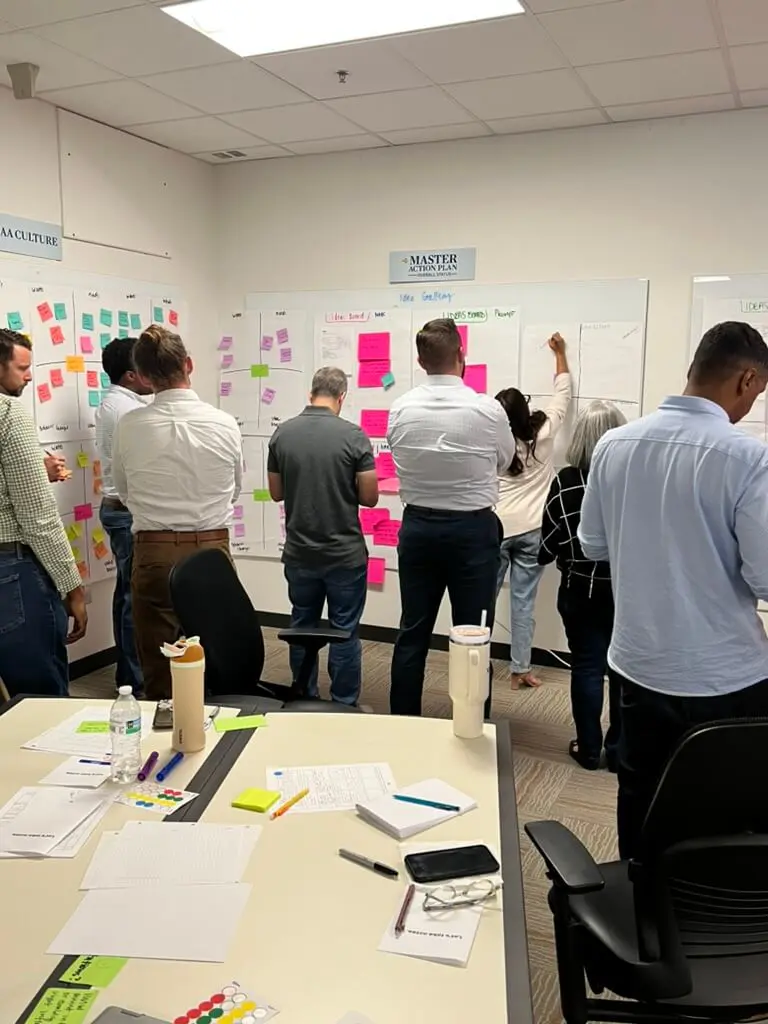
Consultant Handoff Best Practices That Actually Work
January 20, 2026• 11 min read
-
Strategy

Data Governance Consulting: A Function, Not a Committee
October 12, 2026• 8 min read -
Strategy
Digital Transformation in Healthcare: The Record Comes First
September 21, 2026• 8 min read -
Strategy

Team Capability Building That Actually Sticks
January 20, 2026• 10 min read -
Strategy

How to Build a Digital Transformation Roadmap That Ships
July 29, 2026• 9 min read -
Strategy
Reducing Consultant Dependency: 5 Traps That Lock You In
January 20, 2026• 9 min read -
Strategy

Insurance Digital Transformation: Why Programs Stall at the Policy System
September 7, 2026• 8 min read -
Strategy

Digital Product Strategy: Choices That Actually Guide the Work
July 29, 2026• 8 min read -
Product
MVP Development Services: How to Build Your First Product Right
January 5, 2026• 11 min read