
Agentic AI vs. Generative AI: What’s the Difference, and Which Do You Need?


Generative AI creates content when you ask for it: a draft, a summary, an image, a block of code. Agentic AI works toward a goal. It plans the steps, uses your systems to carry them out, checks the results and adjusts, and a person steps in only where you decide they should. That is the core of agentic AI vs. generative AI. Most agentic systems run on a generative model underneath, so the difference isn’t the model. It’s what the system is allowed to do with what the model says.
Last updated: October 24, 2026
That difference changes the stakes. When generative AI gets something wrong, a person reads a bad draft and fixes it. When an agent gets something wrong, it may have already updated a record, sent a message or approved a request. The design question moves from “is the answer good?” to “what is this allowed to do, and who notices when it goes wrong?”
Enterprises are moving anyway. In McKinsey’s 2026 State of AI survey, 40% of respondents at companies with more than $1 billion in revenue said their organizations were scaling AI agents, up from 27% a year earlier. Yet Gartner predicts that more than 40% of agentic AI projects will be canceled by the end of 2027. Both can be true. The difference is usually whether the work needed an agent at all, and whether anyone built the system around the model.
What is generative AI?
Generative AI is AI that creates new content, such as text, images, code or audio, by predicting likely output from patterns it learned in training. Large language models like OpenAI’s GPT, Anthropic’s Claude and Google’s Gemini are the best-known examples. You give it a prompt, it returns an output, and it stops. A person decides what happens next.
That’s why generative AI has been the easy place to start. A person reviews every output before it reaches a customer or a system, so a mistake costs a few minutes of editing. It earns its keep in drafting, summarizing, answering questions over your own documents (retrieval-augmented generation, or RAG), pulling fields out of forms and claims, and writing code.
The limits are just as clear. A generative model doesn’t keep track of a goal beyond the conversation, doesn’t act in your systems on its own, and can state wrong answers with full confidence. Those limits are fine when a person is reading every output. They become the whole problem once nobody is.
What is agentic AI?
Agentic AI is AI that works toward a goal with some independence. It breaks the goal into steps, decides which tools or systems to use, takes actions, checks the results and adjusts until the work is done or it hands off to a person. Where generative AI answers a prompt, agentic AI is given an outcome: “resolve this ticket,” “process this claim,” “reconcile these invoices.”
Every agentic system runs some version of the same loop:
- Plan: a generative model reads the goal and the current state, then decides the next step.
- Act: the system calls a tool, such as a database query, an API, a search or an update in a business application.
- Check: it looks at what came back and tests it against rules and the goal.
- Adjust or finish: it plans the next step, retries, asks a person, or closes out the task.
Around that loop sit access to tools and data (through APIs and open standards like the Model Context Protocol, command-line tools, or a browser the agent works the way a person would), memory of where the task stands, guardrails, and checkpoints where a person approves high-risk steps.
Agentic AI vs. AI agents
The terms overlap but aren’t the same. An AI agent is a single piece of software that carries out tasks on its own, such as one that triages IT tickets. Agentic AI is the broader approach: the agents, the orchestration that coordinates them and the systems they act in.
Not everything called an agent is one
Gartner estimates that only about 130 of the thousands of vendors selling agentic AI offer the real thing. It calls the rest “agent washing”: chatbots and automation tools with a new label. Two questions sort it out. Does the system decide its own next step? Does it act in a real system? If either answer is no, it’s generative AI or automation, and it should be priced and governed that way.
Agentic AI vs. generative AI: the key differences
The main difference between agentic AI and generative AI is what each one produces. Generative AI produces content for a person to use. Agentic AI produces outcomes: records updated, requests routed, tasks finished.
| Generative AI | Agentic AI | |
|---|---|---|
| Core job | Creates content | Completes a task toward a goal |
| Starts with | A prompt from a person | A goal or an event, such as a new ticket or a filed claim |
| Produces | Text, images, code, summaries | Actions in your systems, plus the content those actions need |
| Decides the steps | No. One response per prompt | Yes, within limits you set |
| Touches your systems | Usually read-only, or not at all | Reads and writes through tools and APIs |
| Typical failure | A wrong or invented answer | A wrong action in a live system, a loop, or a runaway cost |
| Who catches mistakes | The person reading the output | Guardrails, monitoring and human checkpoints built into the system |
| What governance covers | Output quality, data privacy, IP | Permissions, approval thresholds, audit trails, a way to stop it |
| Insurance example | Summarizes a claim file for an adjuster | Takes the first notice of loss, pulls the policy, checks coverage, requests missing documents and routes the claim for approval |
Look at where the extra demands land. In almost every row, agentic AI asks more of the system around the model, not of the model itself.
How agentic AI and generative AI work together
Agentic AI doesn’t replace generative AI. It’s built on it. The generative model is the reasoning engine inside the agent: it reads the goal, writes the plan, drafts the message and interprets what each tool sends back. What makes the system agentic is everything wrapped around that model.
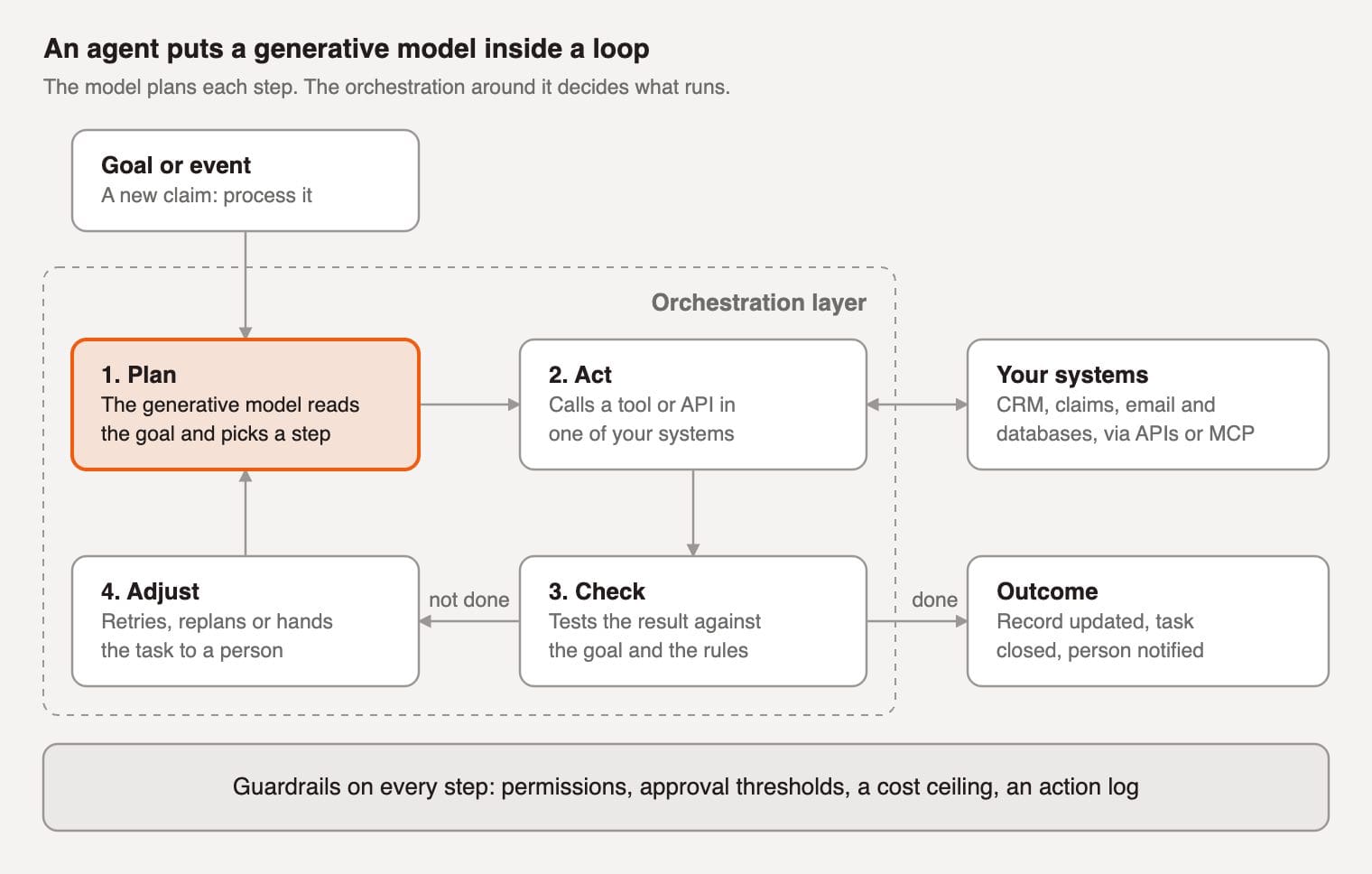
The layer that runs this loop is the orchestration layer. It decides what runs, in what order, with which context, and what happens when a step fails. It’s also where most of the engineering effort goes, and where most agent projects break. We cover the patterns in AI orchestration: where AI products break down and LLM orchestration: 4 patterns we ship in production.
One practical consequence: you can upgrade the model without rebuilding the agent, and you can’t fix a badly designed agent by upgrading the model. A better model writes better plans. Only the system decides whether those plans run.
When to use generative AI, and when you need agentic AI
Use generative AI when the output is content a person will review. Use agentic AI when the work crosses several steps and systems, changes from case to case, and has limits you can write down. If the steps are the same every time, you may need neither: a standard workflow with one generative step is cheaper to run and easier to govern.
That last case is more common than the market suggests. Gartner’s analyst put it plainly: “Many use cases positioned as agentic today don’t require agentic implementations.” Ask these four questions in order:
- Does the work end with content a person reviews before anything happens? Use generative AI. Drafting, summarizing and answering questions belong here.
- Are the steps the same every time? Use rules-based automation, with a generative step where the input is messy, such as pulling fields out of an email before a fixed workflow runs.
- Do the steps vary by case, cross several systems, and happen often enough to matter? You have a candidate for agentic AI. Go to question 4 before you build.
- Can you define “done,” the actions the agent may take on its own, and the ones that need a person? If yes, build the agent. If not, that definition is the first piece of work, and it’s a strategy question before it’s an engineering one. An AI readiness assessment is a fast way to answer it.
Agentic AI vs. generative AI examples
The same team often needs both. Here is how the split looks in three industries we work in:
| Industry | Generative AI | Agentic AI |
|---|---|---|
| Financial services | Drafts client communications and summarizes research | Monitors regulatory changes, maps each one to the policies it affects and opens tasks for their owners |
| Healthcare | Drafts clinical notes from a visit | Gathers records for a prior authorization, checks the payer’s rules, submits the request and follows up |
| IT and operations | Suggests answers for the service desk | Triages the ticket, resets access, confirms with the user and closes it |
The agentic versions that work in production share a shape: narrow scope, one workflow, clear limits and a person in the loop for exceptions. We go deeper in AI agent use cases: what’s actually working in 2026.
What it takes to run agentic AI in production
An agent that works in a demo needs four more things before it can run in production: orchestration, data it can trust, guardrails, and a team that can run it. Gartner’s three reasons for canceled projects, rising costs, unclear value and weak risk controls, each trace back to one of these being skipped.
1. Orchestration that plans for failure
Decide what runs in what order, what context each step gets, how many retries are allowed and when the agent stops to ask. Set a cost ceiling per task so a loop can’t quietly run up a bill. Frameworks like LangGraph, CrewAI and Microsoft Agent Framework handle the plumbing. Open protocols keep you portable: MCP connects agents to tools and data, A2A lets agents talk to each other, and both now sit with the Linux Foundation’s Agentic AI Foundation. The tools are mature. The decisions are still yours.
2. Data the agent can trust
An agent acts on what it can see. If the customer record is out of date or the permissions are wrong, it will act on bad data with full confidence. Production agents need governed access to your systems of record, with each agent allowed to see only what its job requires. Many agent problems turn out to be data infrastructure problems in disguise.
3. Guardrails and governance designed in, not added later
Write three lists before you build: what the agent may do on its own, what needs a person’s approval, and what it must never do. Log every action with its reason so you can audit decisions later, and build a way to pause the agent without stopping the workflow. The NIST AI Risk Management Framework gives you a shared language for the risks. Our AI governance framework and guardrails work turns it into rules the system enforces.
4. A team that can run it
Agents don’t stay finished. Models change, policies change and edge cases pile up. Someone on your side needs to own evaluation, monitoring and change control, or the agent slowly stops doing what you approved. Build capability, not dependency: the people who run the agent should understand why it works, not just that it does. More on that in what AI enablement actually is.
Frequently asked questions
Is ChatGPT agentic AI or generative AI?
ChatGPT is generative AI at its core: an app built on large language models that creates text, images and code when you ask. In July 2025 OpenAI added an agent mode that can browse websites, run code and complete multi-step tasks, and it asks permission before taking consequential actions. So ChatGPT is a generative AI product that can act as an agent when you turn that mode on.
What is an example of agentic AI?
An insurance claims agent is a good example. When a claim comes in, it pulls the policy, checks coverage, requests missing documents from the customer and routes the claim to an adjuster for approval. A generative model reads and writes at each step, but the agent decides the order and takes the actions.
Is agentic AI better than generative AI?
Neither is better. They do different jobs. Generative AI is the right choice when a person reviews the output. Agentic AI is the right choice when a multi-step process needs to run with limited supervision and you can define its limits. Agentic AI also costs more to build, run and govern, so it has to earn its place.
How is agentic AI different from predictive AI?
Predictive AI forecasts. It scores the likelihood of an outcome from historical data, such as a fraud score or a churn risk. Generative AI creates content. Agentic AI acts toward a goal, and it often uses the other two: a predictive score to decide what needs attention and a generative model to plan and write.
What are the biggest risks of agentic AI?
The main risks are actions taken on bad data, actions outside the agent’s intended scope, runaway costs from loops and retries, and decisions nobody can explain afterward. Each has a known control: data access rules, permission limits and approval thresholds, a cost ceiling per task, and a log of every action and its reason.
Where to start
Generative AI made AI approachable. Agentic AI makes it responsible for outcomes, and that takes more design. The agent projects that survive tend to start the same way: one workflow, a clear definition of done, a short list of things the agent must never do, and the orchestration, data access and guardrails in place before anyone talks about scale.
Cabin is a digital experience and AI consultancy. Our senior strategists, designers and engineers help enterprises decide where agents belong, then architect, build and ship them, and leave your team able to run them. If you’re weighing your first agentic workflow, talk to us or start with the free AI readiness scorecard.
Related posts
-
AI

What Is AI Consulting? A Field Guide for Enterprises
May 29, 2026• 12 min read
-
AI

AI Prototyping Without Figma [From a Live Build]
February 27, 2026• 11 min read -
AI

Claims Automation: Automate the Evidence, Not the Decision
September 14, 2026• 8 min read -
AI
Enterprise AI Strategy: Why Most Fail and What Works
April 9, 2026• 9 min read -
AI

Healthcare AI Consulting: What to Ask Before You Sign
March 18, 2026• 17 min read -
AI

Data Integration Consulting: 7 Things Buyers Miss
April 27, 2026• 11 min read -
AI

Build vs. Buy AI: Why the Question Is Wrong
April 9, 2026• 9 min read -
AI

Enterprise AI Operating Model: How to Structure Teams Around Shipping AI
May 4, 2026• 14 min read -
AI

LLM Orchestration: 4 Patterns We Ship in Production
April 27, 2026• 12 min read -
AI

Digital Transformation Consultant in North Carolina: A Charlotte-Based Practitioner’s View
May 4, 2026• 14 min read -
AI

Data Infrastructure for AI: 5 Layers That Matter
April 27, 2026• 11 min read -
AI

AI Readiness Assessment: A Free 6-Point Scorecard
April 27, 2026• 10 min read