What AI Enablement Actually Is, and Why Most Programs Stall

Here’s the uncomfortable truth about most AI enablement: it’s a software license and a hope. Leadership buys seats for a tool, sends a launch email, runs a training session, and waits for productivity to climb. A few months later, a handful of enthusiasts are getting value and everyone else has drifted back to how they worked before. The tool was never the problem. The enablement was.
So let’s be precise about what AI enablement actually is, why so many programs stall, and what it takes to build capability that sticks.
What is AI enablement?
AI enablement is the work of making a team genuinely capable of using AI in their real work, not just giving them access to it. It combines the tools, the workflows, the guardrails, and most importantly the hands-on capability transfer that turns “we have AI” into “our team gets results with AI and can keep improving without outside help.”
The distinction that matters: access is a purchase, capability is a process. You can buy every license tomorrow and change nothing. Enablement is what closes the gap between the two.
Why most AI enablement programs stall
Three failure modes show up again and again.
It’s treated as a tool rollout. Buying Copilot or a chat assistant and announcing it is procurement, not enablement. People get a tool with no sense of where it actually helps their specific job, so adoption is shallow and short-lived.
Training is an event, not a practice. A one-time workshop teaches features. It doesn’t build the judgment to know when AI helps, when it doesn’t, and how to check its output. That judgment only develops through doing the real work with support, over time.
It creates dependency instead of capability. A consultant comes in, does the impressive part, and leaves. The knowledge walks out with them. Now the team has a system and a workflow nobody fully owns. This is the , and it’s the opposite of enablement.
What real AI enablement looks like
Real enablement is measured by what your team can do after the engagement, not by what was delivered during it. In practice that means:
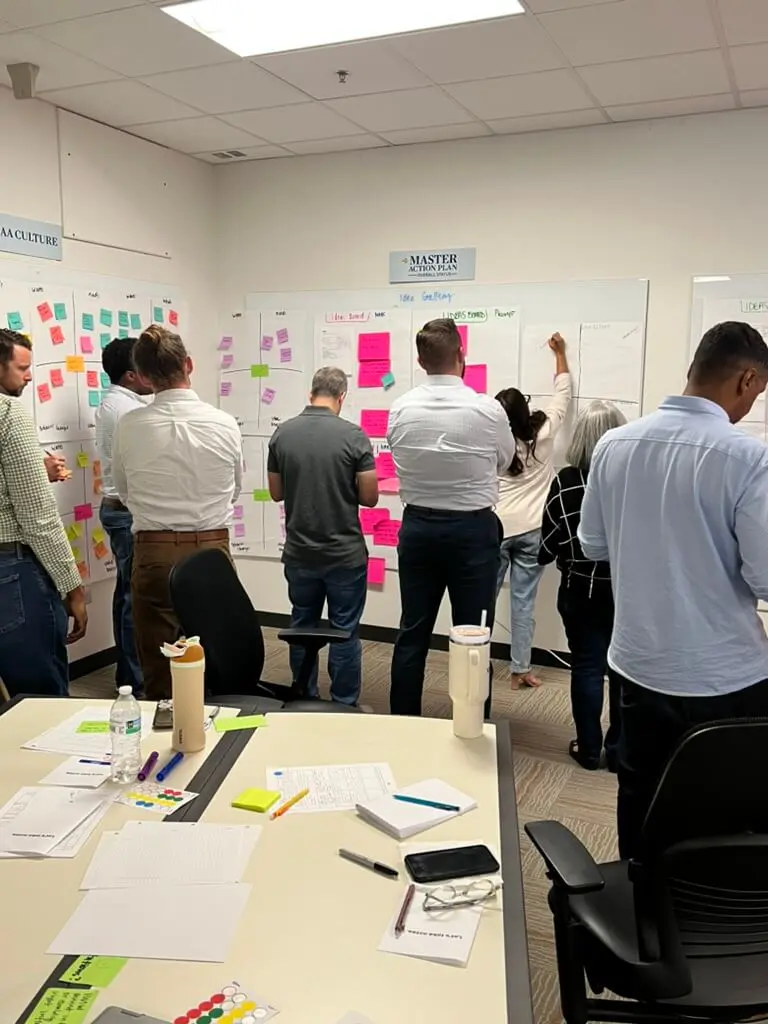
- Pairing, not lecturing. Your people work alongside practitioners on real tasks, so the learning is embedded in the actual job.
- Playbooks they keep. Documented patterns, prompts, and workflows specific to your work, so the knowledge lives in the organization, not in someone’s head.
- Guardrails and judgment. Teams learn not just how to use AI, but when to trust it, how to verify it, and where a human stays in the loop.
- A capability that compounds. The goal is a team that keeps getting better with AI after the help leaves, building .
If a program can’t tell you what your team will independently be able to do at the end, it isn’t enablement.
How to sequence an AI enablement program
A sequence that works, in order:
- Find the real friction. Start from the workflows that actually slow your team down, not from the tool’s feature list.
- Prove value on a narrow use case. One workflow, real results, a team that feels the difference. Momentum beats breadth.
- Pair to build judgment. Practitioners work with your people on that use case, transferring the how and the why.
- Document the playbook. Capture what worked so it’s repeatable without the original people in the room.
- Expand on the team’s terms. Let the people who got value pull AI into adjacent work, with support, instead of pushing it firmwide and hoping.
Sequencing matters more than scale. The programs that fail almost always tried to go wide before anything went deep.
How Cabin does AI enablement
This is the core of how we work, not a service we tacked on. Cabin’s founding team spent two decades building digital products at enterprise scale, the team behind Skookum, which became Method under GlobalLogic and rolled up to Hitachi, and we build capability the same way we build software: with your team, not around it.
While we architect and ship, your engineers pair with ours. You keep the playbook, the component library, and the workflows. By month three, your team runs what we built together without us. That handoff is the , and it’s why our is built around skills, not dependency. Leaders at companies like Twilio, Corning, and Zenefits have vouched for that approach .
Frequently asked questions
What is AI enablement in simple terms?
It’s making your team genuinely capable of using AI in their real work, not just giving them access to a tool. Access is a purchase; capability is a process of workflows, guardrails, and hands-on practice that produces results your team can sustain on its own.
How is AI enablement different from AI training?
Training is usually an event that teaches features. Enablement is an ongoing practice that builds judgment: when AI helps, when it doesn’t, and how to verify it, embedded in real work, with playbooks the team keeps.
Why do AI enablement programs fail?
Most fail because they treat AI as a tool rollout, run training as a one-time event, or create dependency on outside help. The result is shallow adoption that fades once attention moves on.
How do you measure AI enablement?
By capability, not activity. The real measure is what your team can do independently after the program: the workflows they’ve adopted, the judgment they’ve built, and whether they can keep improving without the people who helped them start.
About Cabin
Cabin is an AI transformation consultancy. Our founding team spent two decades building digital products at enterprise scale. We architect AI-native products, ship them, and train your team to own what we build. .