How to Choose an AI Agent Development Company That Actually Ships


Everyone is selling AI agents. Far fewer can put one into production that you’d trust to take real actions inside your business. That’s the gap that should drive your decision, because an agent that acts, calls tools, moves data, makes decisions, is a very different thing to hand a vendor than a chatbot that answers questions.
This is a practitioner’s guide to choosing an AI agent development company: what actually predicts success, and the questions that expose the firms who can only demo.
Why choosing an agent firm is different from choosing any AI vendor
A generative feature that writes a bad sentence is an annoyance. An agent that takes a bad action is a problem. Agents have autonomy, so the things that make them safe, guardrails, human approvals, evaluation, observability, aren’t nice-to-haves, they’re the whole job. When you evaluate an AI agent development company, you’re really evaluating how seriously they take that autonomy. The mechanics of this live in the , which is where agent products tend to get built or quietly break down.
What separates firms that ship agents from firms that demo them
They build for the messy part first
A demo runs an agent on a clean, happy path. Production is messy inputs and real consequences. Ask how they handle the cases where the agent is uncertain or wrong. A firm that has actually shipped agents will have a real answer, because they’ve been burned by it. We’ve written about , and the short version is that the engineering around the agent, not the model, decides whether it survives.
They constrain what the agent can do
Every capable agent firm can tell you exactly what their agents are and aren’t allowed to do, where a human has to approve, and how an action gets rolled back. If “guardrails” gets a vague answer, that’s your signal.
They can prove the agent is reliable
Ask how they measure agent quality. You want to hear about evaluation: test suites, success criteria, and a way to know whether a change made the agent better or just different. Without that, every deployment is a guess.
Senior engineers do the work, and you can see why it acted
Ask who builds it and whether you get observability, the ability to trace why the agent did what it did. Both matter more for agents than for ordinary software, because you’re accountable for actions you didn’t directly write.
You own and can run the agent afterward
This is the one buyers regret skipping. An agent you can’t maintain is a liability sitting inside your operations. Insist on keeping the code, the playbook, and a team that can extend it. The traditional consulting trap, the firm leaves and the knowledge leaves with them, is especially dangerous when the thing left behind is autonomous.
Questions to ask on the first call
- Can you show an agent acting on a real, bounded task within a few weeks?
- What is the agent allowed to do, and where does a human have to approve?
- How do you measure whether the agent is reliable, and will you show me?
- When the agent does something wrong in production, how do you see why and fix it?
- Who does the engineering, and will they be on our project?
- When this ends, can our team run, monitor, and extend the agent without you?
What should you look for in an AI agent development company?
Look for a senior team that ships a working agent on a real task within weeks, builds guardrails and human-in-the-loop controls from the start, proves reliability with real evaluation, gives you observability into the agent’s decisions, and hands your team full ownership. The model is the commodity. The governance and the engineering discipline around the agent are what you are paying for. Which is also why the price varies so widely, a question we break down in AI agent development cost.
How Cabin approaches it
Cabin’s founding team spent two decades building digital products at enterprise scale, the team behind Skookum, which became Method under GlobalLogic and rolled up to Hitachi. We build agents the same disciplined way: a working agent on a bounded task in week one, validation and guardrails by week two, and a production path by week four. Most of our work is in financial services and healthcare, where an autonomous action carries real weight, so governance is structural from day one, not a compliance bolt-on.
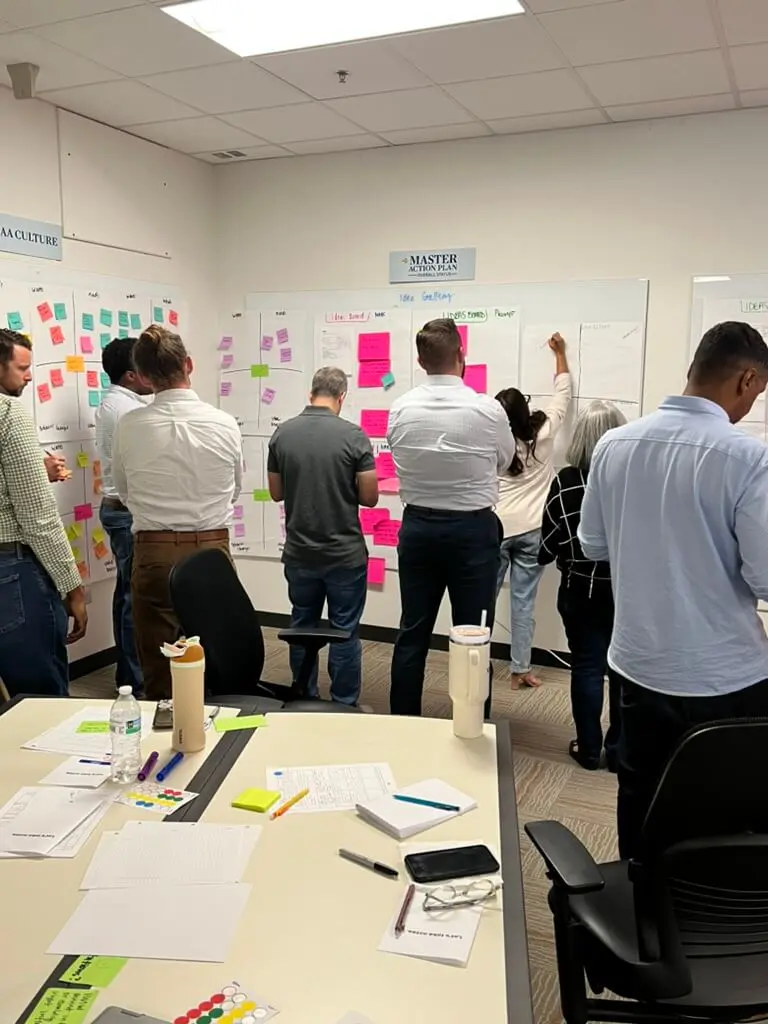
We build with your team, not around it. Your engineers pair with ours, you keep the system and the playbook, and by month three your team runs and extends the agent without us. Leaders at companies like Twilio, Corning, and Zenefits have vouched for that approach . When the surface grows beyond a single agent, that’s , and our team builds toward it deliberately, not all at once.
Frequently asked questions
How much does it cost to hire an AI agent development company?
It depends on how many actions the agent takes, the systems it touches, and the governance required. More useful than a number: ask what drives cost, and whether you’re paying senior engineers to build it or a junior team behind a senior pitch. Price the outcome and the ownership.
How long does it take to build an AI agent?
A capable firm shows a working agent on a bounded task in about a week and a production-ready path within roughly a month. Full rollout scales with the number of actions and integrations and the governance bar.
What’s the difference between an AI agent and a chatbot?
A chatbot answers. An agent acts: it calls tools, makes decisions, and chains steps toward a goal. That autonomy is exactly why agents need guardrails, evaluation, and human-in-the-loop controls a chatbot doesn’t.
Can we trust AI agents in a regulated industry?
Yes, if governance is built in from the start: constraining what the agent can do, requiring human approval on high-stakes steps, logging every action, and being able to audit any decision afterward. If a firm can’t speak to that fluently, it hasn’t shipped agents where it matters.
About Cabin
Cabin is an AI transformation consultancy. Our founding team spent two decades building digital products at enterprise scale, the team behind Skookum, which became Method under GlobalLogic and rolled up to Hitachi. We architect AI-native products, ship them, and train your team to own what we build. .